
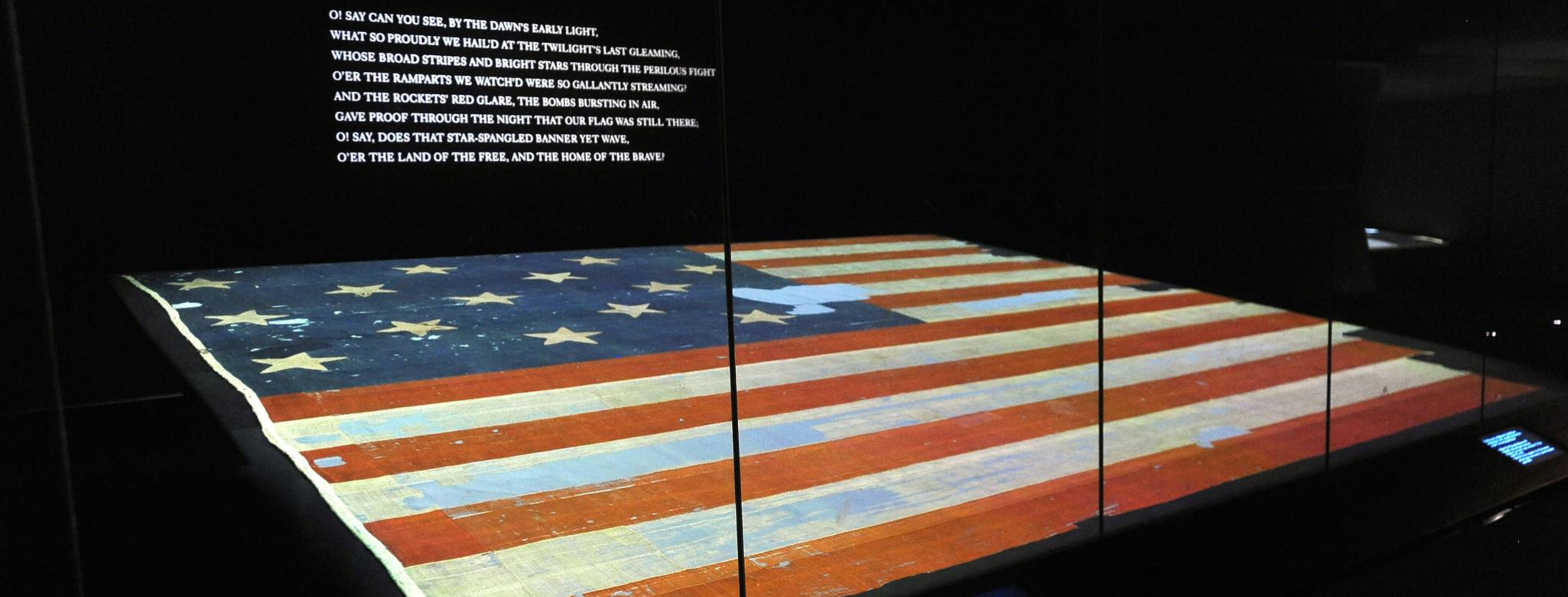
It is September 1814. The United States and Great Britain are fighting each other in the War of 1812. A month prior, the British burned Washington, DC to the ground. As the British fleet bears down on Baltimore, the fledgling United States is in peril of losing a second major city. The war in general is also at a tipping point, as is the nation itself. This is the story of how the Star-Spangled Banner, the United States national anthem, was born—and where you can see the flag that inspired it.
The Battle
As dawn broke on September 13, 1814, British naval ships began bombarding Fort McHenry. As the last defense between the British and Baltimore, the fort’s capitulation would mean disaster for the United States.
Meanwhile, Colonel John Stuart Skinner and Francis Scott Key were aboard a merchant ship in the harbor on a high-stakes mission. On September 5, 1814, they sailed out to meet British Admiral George Cockburn. Their goal: to secure the release of Dr. William Beanes, a well-known physician and Key’s colleague. British forces had captured Beanes for refusing food and drink to soldiers near his home. He faced execution. Skinner and Key successfully negotiated his release. But after learning British plans to attack Baltimore, the British detained all three men at sea. The British didn’t allow them to return to shore until after the battle. On September 13, Key and his companions watched as the barrage of Fort McHenry began some eight miles away.
For 24 hours, the British hurled mortar shells and Congreve rockets at the fort. “It seemed as though mother earth had opened and was vomiting shot and shell in a sheet of fire and brimstone,” Key later wrote. As evening set, Key, seeing the red glare of the rockets and the bursting of bombs, Key thought the British surely prevailed.
To his amazement, the American flag—not the Union Jack—flew proudly over Fort McHenry in the morning! British forces, fatigued from the battle, retreated from the harbor and eventually set sail for New Orleans.
The Poem & Song
Later that morning, Key began writing the words to a poem about the events. Within a week, he had finished “Defence of Fort M’Henry.” Key’s brother-in-law then set the poem to music, using the tune of the British drinking song “To Anacreon to Heaven.” They called it “The Star-Spangled Banner.”

After its publication, “The Star-Spangled Banner” quickly joined the ranks of popular patriotic songs. The song remained popular throughout the 19th century, emerging as a symbol of unity during the Civil War. However, the song was not still the official national anthem.
Becoming the National Anthem
Although the Navy used the song during flag raisings by 1889, the Army would not be outdone. The Army takes credit for starting the movement for “The Star-Spangled Banner” to become the national anthem. A plaque at Old Fort Meade outside Sturgis, South Dakota begins: “On this parade ground in 1892 ‘The Star Spangled Banner’ got its impetus to become the National Anthem.”

In 1916, President Woodrow Wilson named it the de facto national anthem, though he never made it official by law. The “Star-Spangled Banner” finally got its designation by Congress as the official national anthem in 1931.
The “Star-Spangled Banner” did not get this title without objections though. One objection was the song’s origins as a drinking song. Remember, this was during the Prohibition Era. Another objection was the difficulty in performing it. This is something still relevant today as major events like the Super Bowl highlight.
Today, we sing it before sporting and other events. And many may not even know the official name; it’s just the National Anthem to them.
Seeing the Star-Spangled Banner
Visitors can see the original Star-Spangled Banner flag at the National Museum of American History in Washington, DC. It’s part of a permanent exhibition called The Star-Spangled Banner: The Flag that Inspired the National Anthem.
The flag is displayed in a specially designed, low-light chamber to preserve its delicate fabric, and the exhibit includes interactive features and historical context. Due to its fragile state, no photos are allowed.
The National Museum of American History is open daily from 10:00 am to 5:30 pm. Admission is free. Besides the Star-Spangled Banner, there is much more to see. Abraham Lincoln’s iconic top hat from the night he was assassinated is one example. Dorothy’s ruby slippers from The Wizard of Oz is another.
Make sure to include a stop at the National Museum of American History on your trip to Washington, DC. The Star-Spangled Banner exhibit is right in the front. Standing just feet away from the very flag that flew over Fort McHenry in 1814 and inspired Francis Scott Key’s famous words is a moment you’ll remember forever.
Also, consider making a stop at Fort Meade when you are in the Black Hills. The old calvary fort has a museum and you might be able to glimpse the officer candidate training that goes on there now.
Related Posts:
The National Archives: A Document Treasure Chest
Read Between the Columns: The Library of Congress is Epic
Visiting Chalmette: 7 Interesting Things About the Battle of New Orleans