
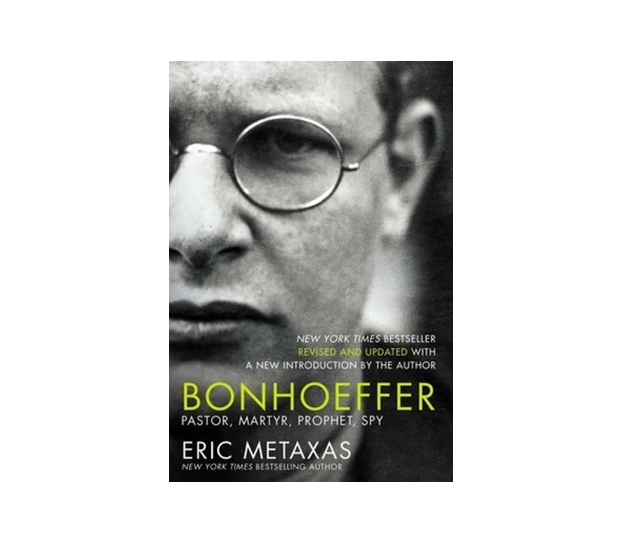
A friend of mine watched a movie about Dietrich Bonhoeffer and thought I might like it. Since I didn’t know who this was, I did a little research…and was fascinated. Instead of watching the movie, I decided to head to the library and check out Bonhoeffer: Pastor, Martyr, Prophet, Spy by Eric Metaxas. In this post, we’ll discuss Bonhoeffer and Metaxas’s book about him.
Early Life
Dietrich Bonhoeffer’s brilliance shone early in his life. He learned the piano quickly and excelled in academics. His family believed this clear potential made him ripe for a distinguished career in medicine or law. However, Bonhoeffer felt compelled to follow a different path.
Much to his family’s surprise—and father’s disappointment—Bonhoeffer believed his calling was theology. And he truly believed this was a calling from God. That unwavering belief and his natural talent resulted in him becoming a prodigy theologian. In fact, Bonhoeffer earned his doctorate in theology at the University of Berlin at the ripe age of 21. Desiring life outside academics though, Bonhoeffer then became an ordained pastor in 1931. Meanwhile, something was brewing in Germany that would require every ounce of that faith to resist.
Resisting Hitler
Two days after Hitler became German Chancellor in 1933, the now renowned Bonhoeffer gave a radio address warning against idolizing political leaders. He maintained God alone deserves our worship. However, the broadcast was mysteriously cut off mid-sentence (an early example of Nazi media control).
Before long, Hitler turned his attention to the church itself. Believing patriotism goes hand-in-hand with faith, many in the German Church made for easy prey to the Nazis. Bonhoeffer saw this early on. He became a founding member of the Confessing Church which resisted Nazi interference with church business. Meanwhile, the church from which Bonhoeffer broke from became the Reich Church. This church promoted something they called “Positive Christianity,” which stripped away Jewish elements and emphasized loyalty to the Führer. The Reich Church went as far as altering the Bible to suit their narrative and making Jesus not only Aryan but antisemitic.
When it came to the so-called “Jewish Question,” Bonhoeffer did not see it as a question at all. He categorically opposed any mistreatment of his Jewish neighbors. He saw early on the Nazi intent with the Jewish community and feared where it may lead. The reality became far worse than even he could have imagined.
From Pastor to Spy
Bonhoeffer’s continual resistance to Hitler and the Nazis painted a target on his back. His family conjured up a plan to shield him from their wrath. By way of his brother-in-law, Bonhoeffer became a member of the Abwehr, Germany’s military intelligence agency, which was the archnemesis of the Gestapo. Through the Abwehr, of which many in its ranks opposed Hitler, Bonhoeffer acted as a double agent. It allowed him to secretly communicate with Allied leaders and convey many within Germany that opposed Hitler. He also sought support for a post-Hitler government.
Further, his role with the Abwehr allowed him to help Jews escape Germany. As a man who championed faith in action over what he called “cheap grace,” this provided Bonhoeffer great satisfaction. It also became the basis for this arrest.
From Spy to Conspirator
In Hitler, Bonhoeffer saw someone who caused so much evil that he was simply too dangerous to be left alive. Although initially considered a pacifist—Bonhoeffer vowed not to join the war as a combatant—he eventually joined the plot to assassinate Hitler. The expert theologian argued that his faith not only allowed for this but compelled him to be a part of it.
Before the plot could come to fruition, the paper trail left behind when he helped Jews escape Germany caught up to Bonhoeffer and led to his arrest. He and those around him believed the resulting prison stint was short term. The letters to his family and fiancée are a testament this. However, the plot to assassinate the Führer, coined Operation Valkyrie, failed on July 20, 1944. Within a year, the Nazis established a link between Bonhoeffer and the coup.
Death and Legacy
With Bonhoeffer already in custody, all the Nazis needed was a place for his execution. He and other members of the Abwehr network were transported to the Flossenbürg concentration camp. On April 8, 1945, Bonhoeffer held a small worship service with his fellow prisoners. He read from Isaiah 53:5—“With his stripes we are healed”—and prayed. Moments after concluding, two men arrived and summoned him. He turned to a British officer and said, “This is the end—for me, the beginning of life.”
The next day, April 9th, Dietrich Bonhoeffer was hung by direct order of the Führer. Within a month, Hitler committed suicide and the war had ended.
Dietrich Bonhoeffer is considered a model for Christian discipleship and a voice of conscience against evil. His writings such as the Cost of Discipleship, Life Together, and Letters and Papers from Prison still influence Christian theology today. He is also recognized as a modern martyr due to paying the ultimate price for his beliefs.
About the Book
In Bonhoeffer: Pastor, Martyr, Prophet, Spy, Eric Metaxas does a fabulous job bringing Bonhoeffer to life. Metaxas uses personal letters, journal entries, and newly available documents to paint a vivid portrait of Bonhoeffer’s courage and faith. At times, the book reads like a spy thriller. I particularly enjoyed the way Metaxas uses foreshadowing to keep readers engaged.
Another great attribute is that Metaxas doesn’t neglect the villains of the story. While his coverage of Bonhoeffer is biography-worthy, he also details the rise of the Nazis. It is tempting to imagine the Nazis of 1945 just showing up in the early 1930s and taking over Germany from within like it is War of the Worlds. However, the reality is that it was a gradual albeit deliberate process with dangerous tools such as deceit and manipulation. Metaxas demonstrates how Hitler and his debutants preyed on the fears and biases of the German people to terrible effect.
Overall, the book is a fascinating read. I highly recommend it to anyone looking for an example of someone living out their faith no matter the cost. It is also great for those wanting to understand the German experience better during the Nazi reign and World War II.
My last note is another plug for immersion reading. That’s when you read the book and listen to the audiobook at the same time. It has greatly increased by concentration and retention. Malcolm Hillgartner is the narrator for Bonhoeffer and is excellent. His pronunciation of German names had me convinced he did them correctly (though I admit I don’t know German). Give immersion reading a try!
Related Posts:
Andrew Jackson Higgins and the Boats that Won World War II, a 3-Minute Review