
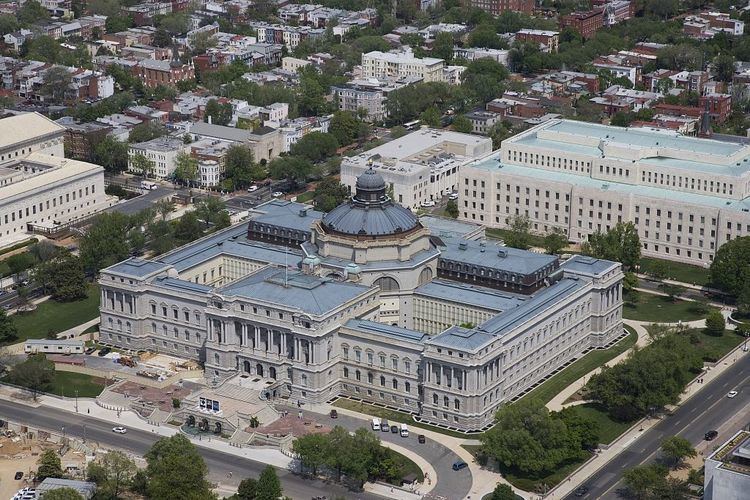
I’ll admit the Library of Congress wasn’t in my top 10 places to visit in Washington, DC. So, seeing it on the tour itinerary did not get the heartrate up. However, another adult on the tour was giddy. I asked her why the excitement? She simply said, “it’s the Library of Congress!” After our visit, I found her and said I now knew what she meant. In this post, we are going to discuss the history, the experience, and why you should visit the Library of Congress.
The Early History
The Library of Congress was established in 1800 when President John Adams signed an act of Congress allocating $5,000 for books to serve the legislative needs of the new U.S. capital in Washington, DC. In 1802, President Thomas Jefferson made the job of Librarian of Congress a presidential appointment. That’s right. The President, not Congress, picks the Librarian (though now the appointment needs confirmed).
Thomas Jefferson still had a part yet to play in the Library of Congress’ history. The Library was originally housed in the Capitol’s north wing. During the War of 1812, the Library’s early collection perished when British troops burned Washington and destroyed the Capitol. Congress purchased Jefferson’s personal library of 6,487 books in 1815. This laid the foundation for the Library’s comprehensive and universal collecting philosophy.
Despite the commitment of two presidents, the Library of Congress struggled in its early years. Space shortages, understaffing, and lack of appropriations curtailed its growth. Fire was a further hazard. A Christmas Eve fire in 1851 destroyed nearly two-thirds of the collection purchased from Jefferson. Besides this, its role was in a limited scope as compared to today. Although it made popular literature available to the general public, the Library’s main purpose was to serve Congress.
The Civil War to Today
Following the Civil War, as the nation stabilized and Washington, DC expanded, Librarian of Congress Ainsworth Rand Spofford capitalized on a rising sense of cultural nationalism to redefine the Library of Congress as a true national institution. Embracing Jefferson’s inclusive vision, Spofford promoted the creation of a comprehensive collection of American publications to serve both Congress and the public. His efforts culminated in the 1870 centralization of US copyright registration and deposit at the Library, a move that significantly fueled its annual growth and cemented its role as the country’s de facto national library.
Spofford further spurred the Library’s growth persuading Congress to construct a much-needed separate building. In 1897, the structure opened to much fanfare from Congress and the public—the largest library in the world at the time. In 1980, it would be christened the Thomas Jefferson Building.
Throughout the 20th century, as its budget increased, so did the Library’s role in the nation and the world. Librarian L. Quincy Mumford asserted in 1962 “the Library of Congress today performs more national library functions than any other national library in the world.” It has also increased to three buildings (the John Adams and James Madison Memorial Buildings opened during this time).
Today, the Library of Congress is arguably the largest library in the world holding more than 178 million items including books, films, photographs, maps, and manuscripts. It supports lawmakers through the Congressional Research Service, offering nonpartisan analysis to inform legislation. The Library also safeguards intellectual property through the US Copyright Office.
The Experience
The Library of Congress Thomas Jefferson Building is open to visitors Tuesday through Saturday between the hours of 10:00 am and 5:00 pm via reserved free timed-entry tickets. There are three must-see places at the Library.
The first is the Thomas Jefferson Library exhibit. The Library of Congress reassembled most of Jefferson’s original collection, using exact copies of the same editions and bindings that perished in the 1851 fire. Jefferson’s own organizational system guides the arrangement of the exhibit, offering a window into the mind of one of America’s most influential thinkers.

The second is the Main Reading Room. This iconic domed space serves as one of the primary reference points for the Library’s general collections. The room is especially popular for research in history, humanities, social sciences, and genealogy. The Main Reading Room invites visitors during public viewing hours Tuesday through Friday from 10:30 to 11:30 am and 2:00 to 3:00 pm, also on Thursday evenings from 5:00 to 8:00 pm as part of the Live at the Library program. For those looking to conduct research, you must be at least sixteen and hold a Reader Identification Card.

The third is just admiring the architecture of the building itself. The elaborate construction of the Thomas Jefferson Building awes visitors today as much as it did when it opened in 1897. The Architecture of the Capitol website puts it best:
When it opened November 1, 1897, writers could not find enough ways to herald the new day they saw for American civilization. The grandeur of the building, its size and scope, the noble artwork and fascinating sculpture left many Americans breathless. Many saw the new building as the fulfillment of American intellectual promise and the perfection of American art. One said that it was “likely to long remain unrivaled in this or any other country,” while another opined, “Not until I stand before the judgment seat of God do I ever expect to see this building transcended.”
In the late 19th century the architectural style of the Jefferson Building was said to be “Italian Renaissance.” Today, it is recognized as a premier example of the Beaux Arts style, which is theatrical, heavily ornamented and kinetic. It is a style perfectly suited to a young, wealthy, and imperialistic nation in its Gilded Age. The materials — marble (15 varieties), granite (400,000 cubic feet), bronze, gold, mahogany — were expensive but would last a thousand years.

Why You Should Visit
The Library of Congress is the de facto national library and hosts arguably the largest collection in the world. With jaw-dropping architecture, the Thomas Jefferson Building is a marvel. It houses the reconstructed Jefferson Library and the immaculate Main Reading Room. Visitors can also see amazing artifacts such as the Gutenberg Bible and original letters from the Founding Fathers. For icing on the cake, the Thomas Jefferson Building is free to visit.
For all these reasons, the Library of Congress is a must inclusion on your Washington, DC itinerary.
Related Posts
The National Archives: A Document Treasure Chest
2 responses to “Read Between the Columns: The Library of Congress is Epic”
[…] Read Between the Columns: The Library of Congress is Epic […]
[…] Read Between the Columns: The Library of Congress is Epic […]